Incentives Drive Human Nature
I get paid to finish the route. My helper gets paid by the hour. Neither of us is wrong, but the company pays us to want opposite things.
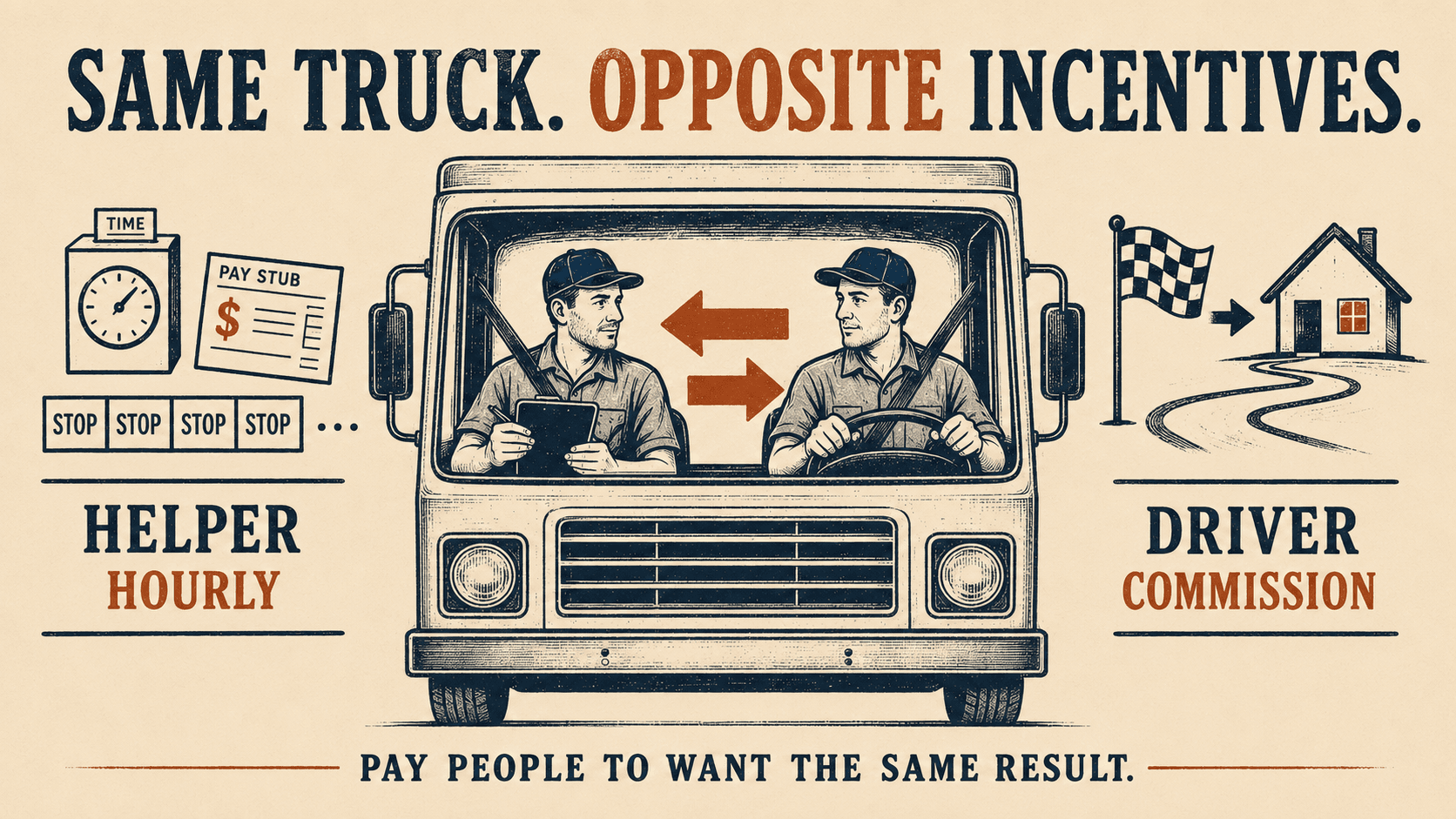
I get paid commission. My helper gets paid by the hour. I need to get home and help my wife. He needs more hours. Then we get put in the same truck and told to finish the same route.
It is not every helper. Some are extremely slow and sometimes just bad at the job. Some are thorough but slow. Then there are helpers who are fast, efficient, and know exactly what they are doing, and those are the ones the company punishes because being good means they finish earlier and get paid less.
I will have a helper tell me, "Man, I'm glad to be done. I'm happy to be working with you. I just need the hours."
I am thinking the exact opposite. Damn, I need to get home and help my wife. I don't get paid anything extra to sit here.
They joke and say, "Hey, if you want to go do that really far stop now, that's totally fine." It is a joke, but there is truth in it. They want the extra hours. I want to finish the route quickly, efficiently, and the right way.
Neither of us is wrong. We are being paid to want opposite things.
People run on incentives
Warren Buffett once said he could fix the federal deficit in 5 minutes by making every sitting member of Congress ineligible for reelection if the deficit went over 3 percent of GDP.
"Now you've got the incentives in the right place."
You can argue about the exact plan. The point is simple. If somebody benefits from one outcome, do not act surprised when they work toward it.
The driver gets paid commission. The helper gets paid hourly. Finish early and one gets his evening back while the other gets a smaller paycheck.
I would pay them to want the same thing
I would put the helper on the same payment setup as the driver, just at a lesser scale. I do not know the perfect percentage. Maybe 50 percent or 75 percent of the driver's route commission. Give them a floor too, because routes change and people still need to know what they are making.
If a helper works with several drivers, give them a set day rate. Finishing the work well should not cost them money.
I would also generally assign helpers to routes. Not set in stone. Things happen. People call out and routes change. But if the same helper keeps working the same route, they learn the stores, the customers, the displays, and what the driver expects. There is less explaining every morning and fewer mistakes throughout the day.
Then put quality on top of the speed. Hold a quarterly competition for the cleanest displays, the best rotation, or whatever the company actually cares about. Make the driver, helper, and salesperson one team.
Salesmen and drivers fight each other too. I am lucky. I have a really good salesperson who is willing to work even though he is not directly incentivized to do it.
I have had many salesmen before him who were the opposite. They were more interested in throwing blame, overselling accounts, not working their product in the store, and not communicating.
I have been in this industry for a little over a decade across 3 beer distributors and one food distributor. Same problems. So I do not think this is only my company. From what I have seen, it is an industry problem. Aligning the incentives would help people stay longer, cut repeat training, and improve the work.
Jim Casey asked the drivers
I remember hearing something about this on the Founders podcast.
Jim Casey built a company by learning the work from the bottom. When he was traveling between meetings and saw a delivery happening, he would have his driver stop. He would walk up without identifying himself and ask the driver what he thought about the job.
He wanted the answer before it passed through a manager and got cleaned up. He also built a network between cities to share methods that worked, then moved when a useful idea came through.
That company became UPS. The founder still wanted to hear from the person carrying the package.
I am carrying the beer, using the invoice system, building the displays, building relationships with the customer, and trying to get home at the end of the route. I can see problems that somebody looking at the operation through a computer probably cannot see.
One mistake takes 8 steps
If I make a mistake on an invoice and need to subtract one Dos Equis, I cannot say, "Take one Dos Equis off that invoice."
I have to go into the invoice, click the little arrow, click Void, give it a reason, go back into it, click Copy to New, open the new invoice, make the adjustment, and print another one.
There are also 2 separate systems. One handles invoicing. The other handles the pretrip and post trip. I think it should be one app. At the start of the day it should require the pretrip before it opens the invoicing side. At the end, the same system should know what has to be completed before the route closes.
We are drivers. We are moving quickly. A voice command could handle the invoice correction while I verify what it changed. Instead, I stop and tap through the same sequence somebody taught every other driver to memorize.
This is where the people doing the physical work can see something the people building the software miss. The process looks complete from a desk because every required button exists. In the truck, it is obviously wasting time.
I have not actually told them this
Here is the part where I have to be honest. I have not suggested this exact compensation setup.
I have suggested other things. When deliveries had to be canceled and shifted to another day, I suggested arranging the days in a more efficient manner. I got, "Yeah, we'll see if we can do something about that."
When I was a helper, I asked if somebody could tell me beforehand when I needed to show up. I completely understand that things change. But if they know when the driver is leaving, they should let the helper know. That did not happen either. I would show up late or really early, but almost never on time, because I did not know when the driver was leaving.
Nothing changed.
So now I see the incentive problem, the route problem, and the software problem, and I have mostly kept it in my head. I cannot say they rejected an idea I never gave them. That part is on me.
But companies train people how much their feedback is worth. If every suggestion gets "we'll see" and disappears, eventually people stop making suggestions.
A Harvard field study across 56 hospital work areas found the same thing. Asking frontline workers for problems hurt performance when managers did not solve them. It worked better when a manager owned each issue through resolution.
Asking without doing anything is worse than not asking. It makes somebody explain a problem, gives them hope it might change, and then proves the conversation did not matter.
This is why I want to own my time
I do not want to be my own boss because I want to work less. I actually like working.
I want to be able to see a problem, fix it, and keep the benefit of that fix.
In my washer and dryer business, I have changed the software over and over because I am also the person installing the machines, collecting payments, taking pictures, sending notices, and dealing with what happens when somebody stops answering. When I find a stupid step, I can remove it. When something breaks, I can make sure the next customer does not hit the same problem.
The work compounds because the system is mine to improve.
At the beer job, I can become faster and see more problems, but I do not have the same power to change what happens next. My effort gets the route done. Then the next day the same system is waiting for me.
If the driver is paid to finish and the helper is paid to take longer, do not give them a speech about teamwork. Fix the incentive.
Pay people to want the same result. Then listen when they tell you how to get there.
Sources:
- Warren Buffett on CNBC Squawk Box: “I Could End the Deficit in Five Minutes”
- David Senra on Founders: #192 Jim Casey (Founder of UPS)
- Anita Tucker and Sara Singer: “The Effectiveness of Management-By-Walking-Around: A Randomized Field Study”