My First AI Client Said Yes... Kind Of.
My first voice agent captured every missed call and still wasn't worth the price. The mechanic showed me what it needed to remember.
I've been testing the voice agent at the mechanic's shop for almost 3 weeks now. After the first week, I went back and asked if he wanted to keep going.
He said, "Yes... kind of."
He wanted to test it for another month at full price. He hadn't seen any big shift in new customers or revenue, and I didn't expect that after one week, but I think I gave him the wrong expectations about what it would do.
The calls were being captured correctly. When he missed one, he got a text with their name, number, and reason for calling. I asked if that was helpful since he didn't have to listen to the recording.
He said yes, sometimes it was nice, but to pay that much for what was basically an answering machine wasn't necessarily worth it.
It was still just an answering machine
He is giving me the same kind of shot he gave the college kid who built his website, but I didn't want him paying for another month of the exact same thing.
I had been listening to the calls and changing it as they came in. Sometimes the agent didn't sound human or wasn't polite, and other times it cut people off. I kept changing the models that listen, process, and speak.
Then somebody would call twice.
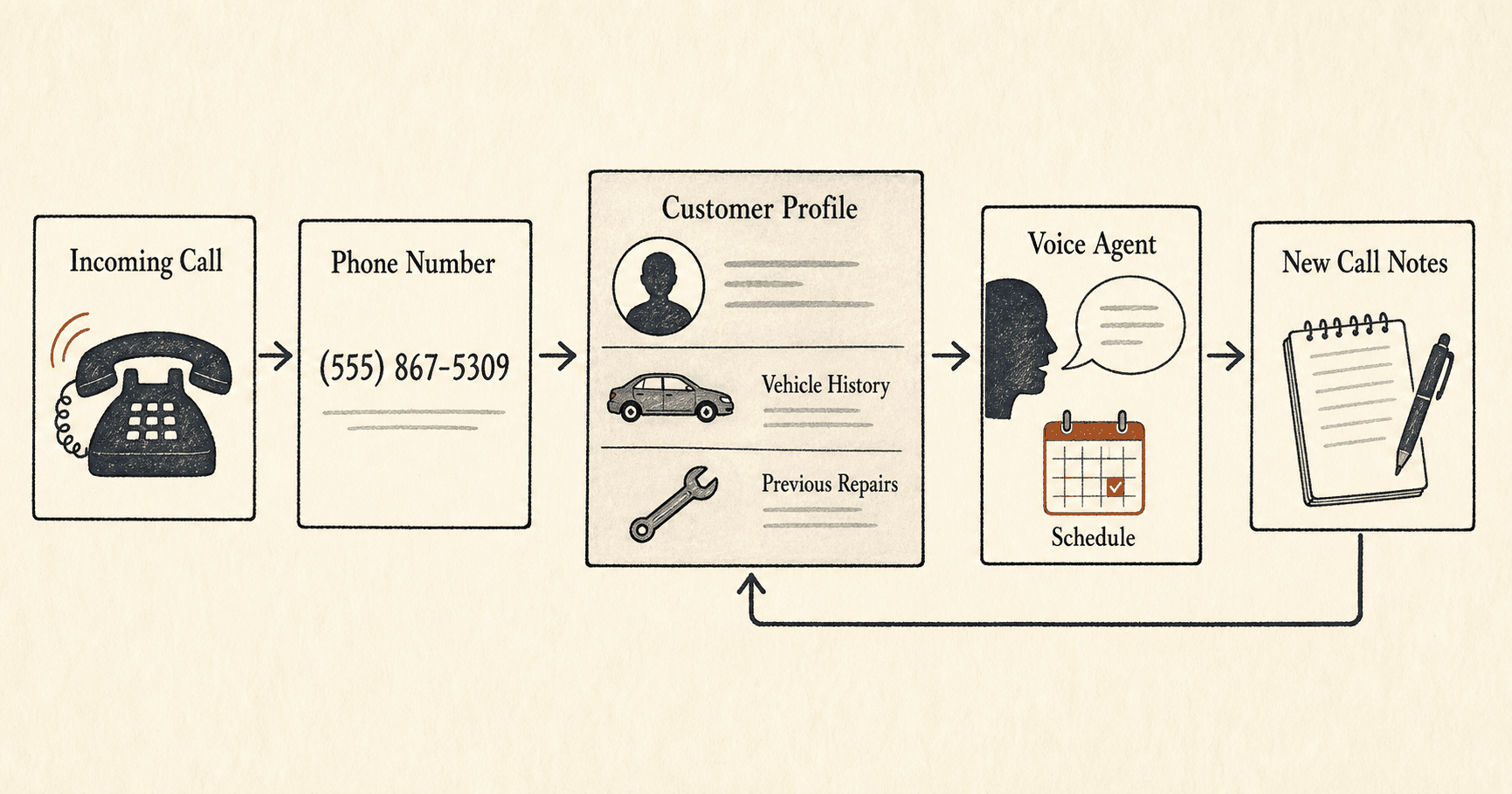
The first time, they might say their AC wasn't working. The agent would get their name, phone number, and what was wrong. Then they could call back later and ask when they could bring the car in. The phone would ring 5 times, the agent would answer, and it would ask their name, phone number, and what was wrong with the car all over again.
It was doing what I told it to do, but it was unnatural. The person already gave us all of that information. If they had called the actual mechanic twice, he probably would have remembered who they were or at least had some idea of what they were talking about. The agent knew nothing from the last call.
So I asked him, "Okay, what would make it worth it to you?"
He didn't know because he doesn't know all of the capabilities. I was asking him to design something with tools he had never used.
He asked me, "What are your suggestions?"
That was the question I had been waiting for.
10,000 data points
I told him the first thing I would do is connect his customer database to the voice agent.
If somebody calls from a number already in the database, the agent should know their name, their cars, what work was done before, and how many times they have been to the shop. Instead of making them start over, it could ask if they were calling about the Honda they brought in last time or if this was another vehicle.
He told me there might be 10,000 data points inside the database and asked if that was way too much for AI to input.
I said, "Absolutely not. That data makes the agent better."
It would not shove all 10,000 data points into every call. I would have it recognize the phone number, call the database, and pull the profile for that person. After the call it could store whatever new information mattered, so the next call starts with more context.
It doesn't need credit card information. I don't want that in there. It needs the customer's name, phone number, vehicles, invoices, and previous repairs.
He also has a basic scheduler on his website. I don't know how often he uses it, but if the agent could see it, it could give the customer a time instead of saying the owner has to call them back.
Then he asked about pricing, which made me nervous. Prices change depending on the car, the parts, and what he finds. I don't want the agent making up a number and committing him to it.
He said there are certain things where he knows the price. AC work was one example. We could make a spreadsheet of only the services he approves, put strict rules around those, and everything else would go back to him for a personal quote.
He thought the Mitchell 1 database might be sealed. I told him most systems aren't sealed entirely and there is normally some way to get the information. I found that Manager SE can at least export the data, and Mitchell 1 has a service called SE Connect that handles some of its cloud connections, but I still need to find out what his version will let me connect.
I think I misunderstood what he wanted from the beginning. I thought he wanted more calls answered. He may want something closer to an AI marketer that helps increase customers, and the voice agent is only one part of that.
I am still glad I built all of it
I've built StageInSeconds.com, IroncladSpecs.com, Faceread.Live, and this site, and I've gotten almost no traction on any of them.
I'm still so glad I built them.
They taught me how to build, what problems I normally run into, how to make things cleaner, how to make them not look or talk like AI, how much I can remove, and how to create skills and other artifacts that AI can pull from next time. I wouldn't know how to make this voice agent without all of the other stuff that nobody used.
The blog posts are different. I know right now almost nobody is reading them, viewing them, or whatever you want to call it. I don't care. Writing this down helps me let it out and organize my thoughts. Maybe eventually somebody reads it and it helps them, but right now it gives me something I can go back to and see what worked and what didn't.
RentWashersSA is the thing that actually got customers because people already needed washers and dryers. I didn't have to figure out how to make them want it.
I've made more than 140 GitHub commits to that website because I kept running into things I had to fix. I built my own backend. Customers fill out paperwork through a link on their phone while I'm installing. I can update the terms, keep pictures of every unit under the right account, and send a new link when something changes.
A lot of it did not work the first time. Buttons broke. Payments took too long. I kept changing it because people were already using it.
Right now I have my first customer who went a full month without paying and stopped answering me. I sent messages and then sent certified mail. If that doesn't work, I will go through the formal process of recovering my washers and dryers.
That is not something I thought about when I was building a SaaS product. Those are my machines inside somebody else's house, so the paperwork, payments, pictures, and customer records have to work.
The same thing is happening with the mechanic. I would not have thought about a repeat caller until I listened to one start over with the agent.
I don't know where this goes yet
I listened to Eric Glyman from Ramp on David Senra's podcast. He talked about determined generalists being able to do more now and how he looks for proof of work instead of only looking at a resume.
Then I found his LinkedIn post saying Ramp only hires builders. I replied with what I built for RentWashersSA because it made me look at all of this differently.
The SaaS products didn't get customers, but I still built them. The washer business has more than 140 commits because I kept fixing what was in front of me. Half the time I don't know how to do something until the problem is sitting there and I have to figure it out.
I don't have a degree that proves I know how to do all of this. Maybe the things I built are the proof. I don't know.
I would like for this to turn into a job somewhere that wants an AI generalist who likes building and figuring things out. I also want the mechanic to feel like the money he pays me next month is worth it. Right now I have to find out what Mitchell 1 will let me do, get the pricing sheet back from him, connect what I can, and keep listening to the calls.
Then we will see if it actually changes anything.
Earlier in this thread:
- My First AI Client Doesn't Use Computers.
- I Built 26 Products. The One That Worked Rents Washing Machines.
Sources:
- Mitchell 1: Manager SE data export instructions
- Mitchell 1: Manager SE and SE Connect
- Eric Glyman on David Senra: the episode
- Eric Glyman: "We only hire builders"