They Found Me in ChatGPT. I Didn't Have the Washer.
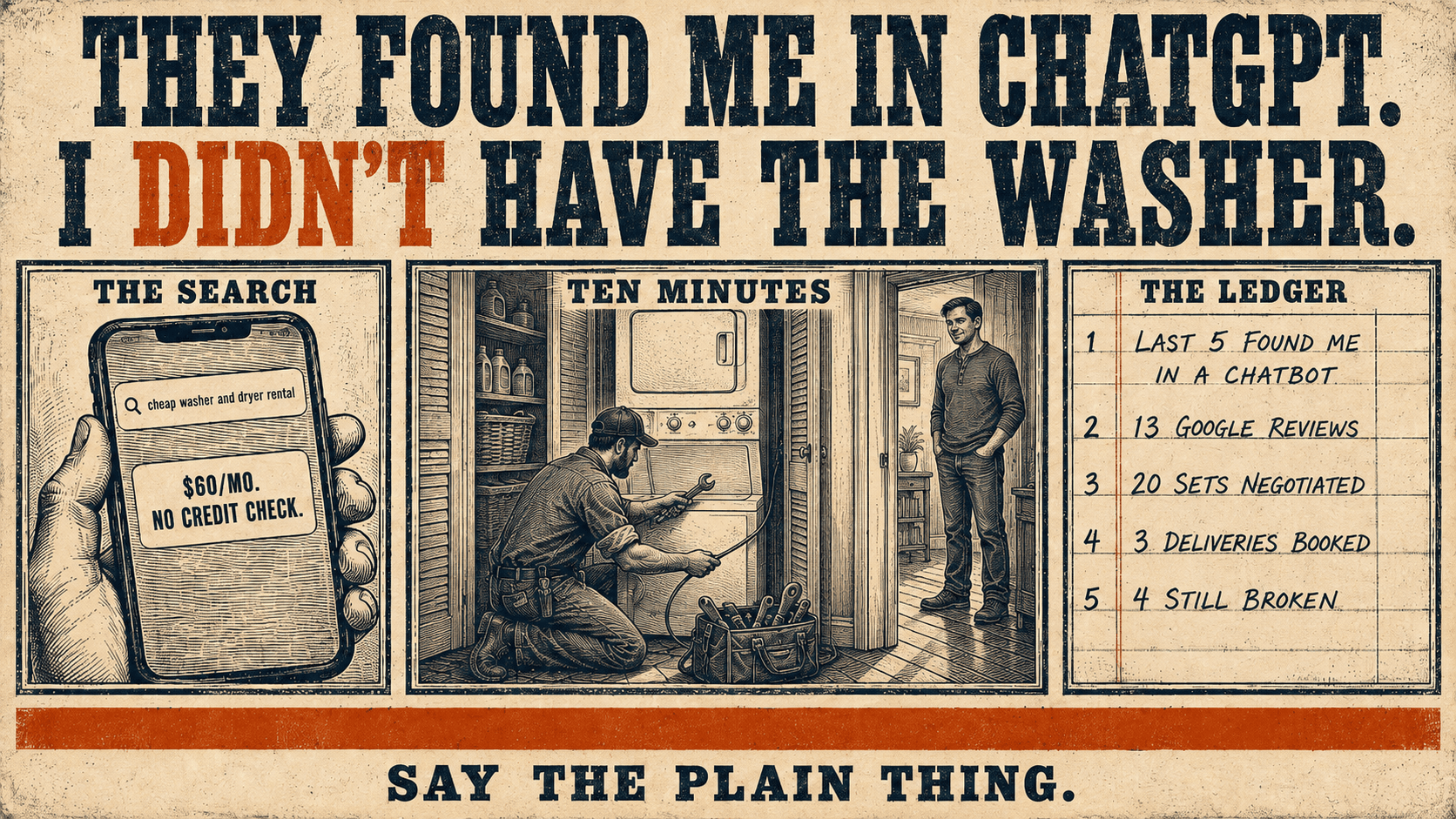
My last 5 customers found me inside a chatbot. I said yes to every one of them before I owned the machines, then spent the week scrambling to make it true.
I sold one of the stackables today.
I drove it out to the guy's house myself. He was buying it for his daughter's family. The install should have taken 10 minutes.
Then the thing ran with the ground not attached, and that scared me. I wasn't leaving until he was satisfied his daughter's family was safe and had a washer and dryer that worked, so 10 minutes turned into an hour. Turns out some of these builds need the internal ground bridged to the neutral.
On my way out he asked if I wanted a newer machine he had sitting there with a burnt wire. I told him I'd take a shot at it. So I drove home with my money back and then some, plus another machine to fix.
Here's what the days before that looked like.
I told a woman yes on a side by side I did not own. Then I sat on Marketplace like it was a second job, negotiated with 15 or 20 strangers over cheap sets, bought 2 sets pieced out because pieced out was what I could afford, fixed a washer of my own that is still not great, and got sets ready for 2 deliveries this weekend and another next weekend. Every time money came in from a delivery I spent it on the next unit. I somehow made it all work.
I said yes to all of it before I had any of it.
Last week that was my confession. This week I'll say the other half out loud, because I think it's the actual engine. If I have the sale, I know exactly what I'm working for. If I don't have the sale, I can't tell you what any of it is worth.
Scrambling is uncomfortable and I'm good at it
Scrambling looked like sitting at the laptop at night recoding a new rent to own agreement into my CRM. Checking the account to see what I actually had to work with before I could buy anything. Checking new customers. Selling new customers. Going through the units already out there to make sure they're up to par. Then back on Marketplace to see if somebody 30 minutes away was dumping a set.
None of it felt good while it was happening. It felt like being behind.
I don't want to sound cocky, but I'm good at it. When push comes to shove I make things work. I think it's from sports. I like winning at things, even small ones, and when it's live I get better instead of worse. That might be the only real advantage I have over a company with a warehouse.
The bill for it is standing in my garage right now. 4 units I still have to repair, plus the burnt wire one I just took on. One that runs fine except the latch, and a stackable that works and won't sell. That's money standing up doing nothing, and I know it.
The sale is the measuring stick
I built 26 products in 34 months and sold almost none of them. For most of that stretch I could not have told you which one was worth anything, because nobody ever put money on the other side of it. Worth was a guess I was making about myself.
A sale ends the guessing in one phone call. When somebody needs a set in her apartment by Saturday, every hour between now and Saturday has a price on it. I know what to buy, and which washer in the garage matters.
That's also where I got it wrong two weeks ago. Two people asked me about stackables and I heard a sale. Asking isn't buying. I spent $400 on a question, and the question walked.
I got that money back today off one of them. It took weeks, a drive across town, and an extra hour on a stranger's floor to make a bad decision come out okay. I'll take it. It doesn't make it a good decision.
I started this business by selling something I didn't have
I posted asking if anybody wanted to rent a washer and dryer. I didn't have an extra washer and dryer. I had a garage full of moving boxes and a post. Somebody said yes, and then I had to go be a company.
Once I promise somebody, I take it seriously. The discomfort of owing a machine I don't own yet is something I'm making peace with.
Weirdly enough, that's the enjoyable part of doing this inside your own business instead of for somebody else. You see the return. You decide how a customer gets treated, and watch it come back to you.
Those extra 50 minutes on that guy's floor, after the machine was already running, are the entire business. Nobody made me stay. He watched me not leave, and on the way out he handed me a machine. Knowing how to talk to people is most of this job. Understanding what they're actually worried about, taking care of every single one of them so they feel taken care of. That carries. Word of mouth is huge. Reviews are huge.
The last 5 customers found me inside a chatbot
I ask every single person how they found me. The last 5 said ChatGPT. The most recent one said Gemini.
Not Google. Not Facebook. Not a sign on a truck.
They weren't typing anything sophisticated. Cheap washer and dryer rental. Washer and dryer rental on a budget. Regular words. I come up number one on ChatGPT for most of it, and one or two on Gemini depending on how it's phrased.
So I asked both machines why they were recommending me. Same answer both times. I answer the question in the same language people ask it.
My headline is not clever:
Washer and Dryer Rental in San Antonio $60/month. No credit check. Free delivery and repairs.
Under it is a list of the questions people actually ask, answered flat:
Do you check credit? No. The rental offer does not require a credit check.
How much is washer and dryer rental in San Antonio? The standard rental set is $60/month.
That's the whole thing. It's what I'd tell you if you called me.
Claude Hopkins wrote this down in 1923
One of my agents broke down a Founders episode on Claude Hopkins last week and left it in my notes before my route. It was uncomfortable reading, because it is my website with the serial numbers filed off.
Hopkins had been writing ads for 30 years by the time he published Scientific Advertising, and he treated it as salesmanship, not decoration. Platitudes roll off people like water off a duck. Specific beats grand. Sell the service, not your own importance. He sold a razor on a 78 second shave and beat everybody advertising the finest quality. He walked a brewery, wrote down the ordinary steps every brewer already took and nobody said out loud, and Schlitz went from fifth to first.
The national rent to own companies sell flexible lease solutions for household essentials. I sell a washer and dryer for $60 a month with no credit check and free delivery. Only one of those is a sentence a person would say out loud.
Here's the new part. For 100 years the plain specific sentence just worked better on people. Now there's a machine in the middle deciding who gets mentioned at all, and it's built to find the text that answers the question. It doesn't care that I have 13 reviews and the national guys have thousands. It cares that somebody typed cheap washer and dryer rental and my page holds that answer in those words.
I want to be honest about my part in it. I did not do that on purpose. Or maybe I did and didn't know it, which is closer to the truth of most things I've gotten right.
The plain answer doesn't come with a filter
Here's the catch, same story as the stackables.
One of the questions on my page asks whether I have stackable sets for apartments. I answer honestly. Yes, when inventory allows. That's exactly how two people found me, asked for the one machine I promised myself I'd never carry, and cost me $400 and a month of garage space.
Answer plainly and people will ask you for exactly what you said. Including the thing you're worst at.
So the page can't be the filter. I have to be.
Say the plain thing, in the words your customer would use to ask for it. Take the order for the thing you're actually built for. Then go make it true before Saturday.
Earlier in this thread:
Sources:
- David Senra on Founders: How to Make Ads That Sell: Scientific Advertising by Claude Hopkins