Seek the Problem, Not the Customer.
I found a customer before I found his problem, then spent 5 weeks building the wrong thing. The call logs had been telling me so the whole time.
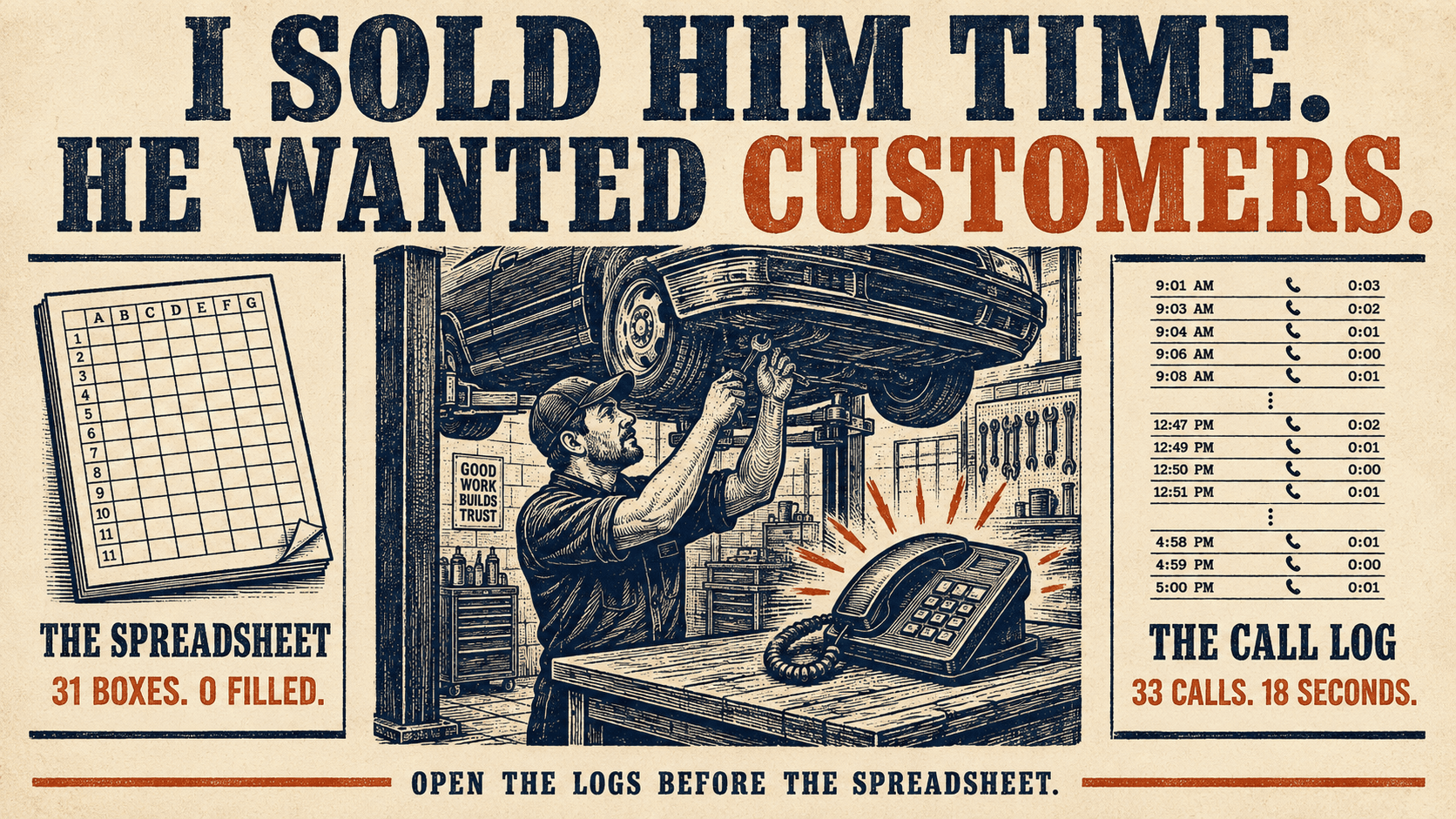
I built Abdul a pricing sheet. 31 boxes. What a standard oil change runs on a Civic, on a Camry, on an F-150. Front brake pads. A battery. A state inspection.
I have asked him for it 3 times. He has never filled it out.
I decided that empty sheet was the problem. I was wrong, and I had everything I needed to know it.
The 31 boxes
It is 20 minutes of work, most of it stuff he says out loud on the phone every day. He is not blowing me off either. He runs most of that shop himself and he is under a car. A text asking him to open a spreadsheet was never going to beat the car.
Here is why I wanted it so badly. There is a line in the agent's instructions that I wrote myself:
Never give a price, range, estimate, or ballpark of any kind.
An agent that guesses at a brake job is worse than no agent at all. But that one rule turns every price question into the same answer: Abdul likes to put eyes on the car before he prices it, when could you swing by. That is a callback. It is not an answer.
Somebody calling an auto shop at 8pm wants a number. They want to know if this is a 200 dollar night or an 800 dollar night. The sheet was how the agent finally gets to tell them something instead of taking a name and promising a call tomorrow. Feed a voice agent real prices and it has more to work with. I still believe that.
So that was the story in my head. The agent feels like an answering machine because it cannot resolve anything. Get the sheet.
Then I counted them
33 calls.
15 of them ended in under 10 seconds. The median call is 18 seconds long. 28 of the 33 ended because the person on the other end hung up. 4 calls produced an actual message with a name, a number, a vehicle and a problem.
Price came up in 3 calls.
3 out of 33.
I had been chasing a spreadsheet that would have improved the experience of 3 phone calls.
The logs only go back 2 weeks, and not because I deleted anything. My plan keeps 14 days of call history and then it is gone. I found that out while writing this, which means the first month of this trial already rolled off and I never saved it anywhere.
Even so, the shape of it is not subtle. These calls are not dying at the price question. They are dying at hello. Somebody calls the shop, hears a voice that is not Abdul, and hangs up before the second sentence.
And I cannot even tell you I never looked. I have been listening to these calls as they come in. I heard people hang up 2 seconds into the greeting. I knew, and I kept working on the sheet anyway, because the sheet was my idea and my idea was the one I wanted to be right. That is worse than not checking. I checked, and then I argued with it.
I sold him time back. He is trying to get customers.
He pays me 250 dollars a month. 4 captured leads in 2 weeks works out to about 62 dollars a lead.
When I asked him about renewing he said he is still not seeing a difference, but he wants to give it a bit more time. He paid anyway. I took the money, which makes it a real business no matter what happens next.
He did give me credit for one thing. The agent takes the name, the number and the reason for the call and emails it to him, so he never has to sit and listen to a recording to find out who called. He said that part is nice.
He also said it is not a needle mover.
That is the whole engagement in one sentence, and it is not an insult. It is a man telling me exactly where the line is between convenient and valuable. The agent takes messages and hands him time back. Abdul is not measuring time. He is measuring new customers walking through the door. I built something that saves him an hour and sold it to a man who is counting cars in the lot.
That mismatch is mine, not his.
I already know how to do this with washers
The stupid part is that I fixed this exact problem in my other business a year ago.
I do not hand a washer and dryer to whoever messages me first anymore. Before I load anything on the truck I ask for the address, a phone number, pictures of the space, and a picture of the plug. Some of it is practical. A dryer has to fit and the outlet has to match.
But the answers are not really the test. How fast somebody comes back is the test. Whether they are polite. Whether they treat it like a transaction between two adults. The people who send 4 clear photos the same afternoon pay on time and answer their phone. They are pickier than the rest, and I do not mind picky at all as long as the money shows up when it is supposed to.
Charlie Munger said trust is one of the greatest economic forces on earth. I believe that, and I still want to be generous first. Give somebody real value before you ask them for a dollar, eat a bad customer or two, and it comes back around. That is how I got Abdul. I wrote him a free guide on handling bad reviews before I ever pitched him anything.
Generosity is not the same as flying blind. The pictures of the plug are not distrust. They are a 5 minute test of whether somebody wants the thing enough to participate in it.
I ran that test on Abdul after I built his agent instead of before. The unfilled spreadsheet was the result coming back. I just did not read it as a result.
What a shop that actually wants this looks like
I have started looking at other shops, and I finally know what I am looking for.
The right customer is a shop trying to save time, not a shop trying to get more leads. That is the whole filter. If somebody's real problem is that the phone rings while their hands are in an engine, this fixes their week. If their real problem is that not enough people call in the first place, I am selling them the wrong thing and they will tell me so in 30 days.
So the sheet moves to the front. It becomes the first thing I ask for instead of the fortieth. If it comes back filled out inside a week, that shop wants this and I build. If it does not, I learned that for free instead of a month and a build later.
Then, in order, here is what I am doing with Abdul.
Fix the first 5 seconds. I have gone through the calls now, and most of the people who leave are gone before the greeting finishes. That is where the work is.
Fill the sheet out with him instead of sending it to him. Stand in the shop, ask him what a front brake job runs on a Camry, write it down myself. Or pull the 5 services people actually ask about on the phone and only ask him those.
Then stop adding to the agent. Because the agent is not the thing he asked me for.
He already told me what a win looks like
I did ask him, early on. What would a great outcome for this thing be. He said more customers.
That answer has been sitting there the entire time and I built around it instead of at it. A voice agent does not make a phone ring. It answers one. Every hour I have put into prompts, models and 31 boxes improves what happens after somebody has already decided to call him.
He is asking for the part that happens before.
So the honest next offer is not another feature. It is his website. Local SEO, Search Console, the words people actually type when their car starts making a noise on a Tuesday night in San Antonio. That is the work that makes a phone ring, and it is the same work I have already done on my own rental site.
The part that makes me hesitate is that a college kid built his site, and Abdul gave that kid the same shot he gave me. I am not walking in there to take somebody's work away from them. I would rather add the piece nobody is doing than replace the piece somebody already is.
The tools were never the hard part. I built a working voice agent for an auto shop on a laptop, and anybody reading this could do the same thing this month. What I got wrong is older and dumber than that. I went looking for somebody who would pay me. I found one, took the money, and spent 5 weeks building him the wrong thing, because I never went looking for his problem first.
Seek the problem you solve. The person who pays you comes after that, not before it.
Earlier in this thread: